
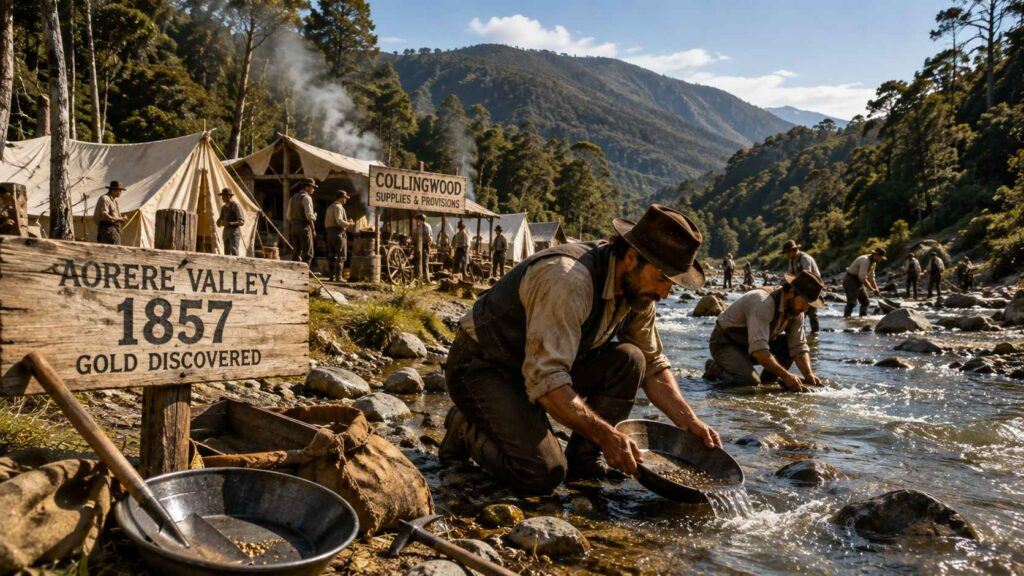
The scattered discoveries of gold in Golden Bay during the early and mid-1850s had created curiosity, but in 1857, a major gold discovery in the Aorere Valley changed everything.
Prospectors working the Aorere Valley began recovering enough gold to prove that this wasn’t simply a handful of lucky finds. There was payable gold spread throughout the district, and as increasingly encouraging reports reached Nelson, men began making their way across the bay hoping to claim a piece of the new goldfield.
Within months, the quiet Aorere Valley had been transformed.
Miners appeared along creeks and gullies. Camps were established in the bush. Supplies began moving through Collingwood. New discoveries pushed prospectors deeper into the valley.
The Aorere Gold Rush had begun.
William Lightband and the Search for Payable Gold
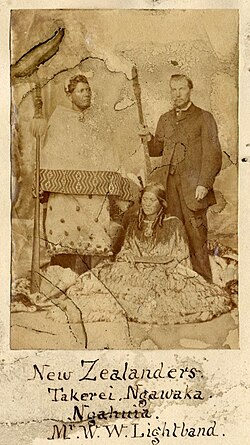
One of the most important names in Golden Bay’s early gold history is William Lightband.
Lightband had previous gold-digging experience in Australia and travelled to the Aorere district with Nelson storekeeper William Hough. They began prospecting gullies in the area, with Lightband later continuing the search with assistance from local Māori.
Eventually, around three ounces of gold were sent back to Nelson.
It wasn’t an enormous fortune, but it provided something arguably more important—evidence that determined prospectors could recover meaningful quantities of gold from the Aorere district.
Lightband reportedly estimated his early earnings at around 10 shillings per day.
That was enough to get people’s attention.
As word spread, others began travelling to the Aorere to try their luck.
Slate River Changes Everything
Prospectors gradually pushed beyond the initial workings and explored tributaries flowing into the Aorere River.
One of the most important discoveries came at the Slate River.
Historical accounts record that three men working there recovered approximately 100 ounces of gold in seven weeks.
Now people really started listening.
This was no longer simply a few flakes appearing in a gold pan.
The possibility existed that the Aorere Valley contained a genuine, commercially worthwhile goldfield.
News travelled back to Nelson, and excitement grew rapidly.
Gold Fever Reaches Nelson
Reports of successful miners had a powerful effect.
Gold recovered from the Aorere was transported back to Nelson, where people could see physical evidence of the discoveries for themselves.
One contemporary newspaper report described around 50 ounces of Aorere gold being displayed in the window of a Nelson watchmaker.
Imagine walking through Nelson in 1857 and seeing that.
For someone struggling to make a living as a labourer, farmer or tradesman, the temptation must have been enormous.
There was gold sitting in the rivers across the bay.
You simply had to go and find it.
The Gold Rush Begins
The number of miners increased rapidly.
By 1 May 1857, historical estimates suggested that around 1,000 men were already working the Aorere diggings.
Over the broader period of the goldfield, around 2,000–2,500 people are believed to have been attracted to the district.
Some were local settlers.
Others came from elsewhere in New Zealand.
Experienced miners also crossed the Tasman from the Australian goldfields, bringing knowledge of prospecting and alluvial mining techniques with them.
Golden Bay suddenly had a very different population.
Life On The Aorere Goldfields
Finding gold was rarely glamorous.
The miners worked long days standing in cold streams, shifting enormous quantities of gravel and searching for the tiny particles of gold hidden amongst it.
Their equipment was relatively simple.
Common gold mining tools included:
- Gold pans
- Picks and shovels
- Cradles or rockers
- Sluice boxes
- Buckets
Simple water races
Everything had to be carried into the workings.
And the deeper prospectors travelled into the Aorere Valley, the harder supplying them became.
There were few proper roads, thick vegetation covered much of the country, and river crossings could become dangerous after heavy rain.
Following The Gold Deeper Into The Valley
As the easily accessible areas became crowded, prospectors searched further afield.
Creeks, gullies and tributaries throughout the Aorere district were tested.
Some contained very little.
Others produced enough gold to encourage further exploration.
The geology of the region meant that gold washed from ancient rocks had accumulated within river gravels over enormous periods of time.
This alluvial gold tended to settle amongst heavier gravels, behind large rocks and within cracks in the underlying bedrock.
Finding the right patch could mean the difference between weeks of disappointment and an exceptionally profitable claim.
Collingwood Became the Gateway to the Goldfields
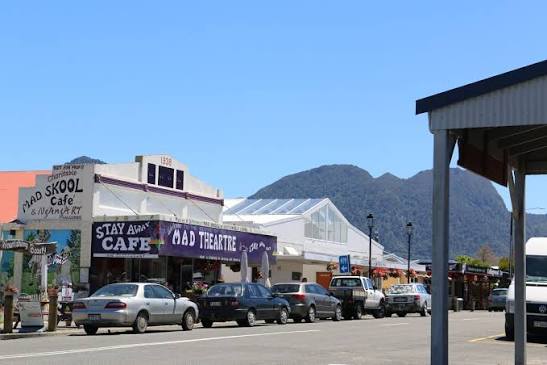
The gold rush didn’t only transform the rivers.
It transformed Collingwood.
Situated near the mouth of the Aorere River, the settlement became the natural gateway to the diggings.
Miners needed food.
They needed tools.
They needed accommodation, clothing, transport and supplies.
Businesses appeared to serve them, while boats travelled between Nelson and Golden Bay carrying passengers and goods.
For a short period, Collingwood found itself at the centre of one of the most exciting developments in the young colony.
The gold hidden within the mountains was beginning to reshape the entire community.
Golden Bay Before Otago
This is one of the most fascinating parts of Golden Bay’s history.
The Aorere rush occurred four years before Gabriel Read’s famous discovery at Gabriel’s Gully in Otago in 1861.
Golden Bay was therefore one of the earliest places in the South Island where a substantial population of miners gathered to work a recognised goldfield.
Later gold rushes in Otago and on the West Coast would become vastly larger and ultimately overshadow the Aorere story.
But Golden Bay got there first.
Before Queenstown.
Before the great Central Otago goldfields.
Before the West Coast rushes.
Men were already standing in the rivers of the Aorere Valley searching for gold.
Gold Gives Golden Bay Its Name
There’s another wonderful connection between this history and the place we know today.
Golden Bay hasn’t always been called Golden Bay.
Abel Tasman originally named the area Murderers’ Bay following the violent encounter between his crew and Māori in 1642. It later became widely known as Massacre Bay.
Following the discovery of gold, however, another name began appearing:
Golden Bay.
The name was inspired by the goldfields developing around the Aorere Valley.
Eventually, Golden Bay became the name that endured.
So when we say Golden Bay today, we’re still carrying a small piece of the 1850s gold rush with us.
Golden Bay Becomming More Than Just Gold
The real legacy of the 1857 discoveries goes far beyond the amount of gold recovered.
The rush brought people into Golden Bay.
It encouraged exploration.
It created businesses.
It expanded Collingwood.
It opened tracks into previously difficult country and drew attention to the extraordinary mineral wealth and geology of the region.
Perhaps most importantly, it created stories.
Stories of people leaving everything behind to search a remote river.
Stories of lucky discoveries and disappointing claims.
Stories of hardship, perseverance and adventure.
More than 160 years later, those stories remain part of what makes Golden Bay such an extraordinary place.
The Beginning Of Something Bigger
The discoveries of 1857 proved beyond doubt that there was payable gold in the Aorere Valley.
For a brief moment, Golden Bay became a destination for people dreaming of changing their lives with a shovel, a gold pan and a little bit of luck.
But the rush was only beginning.
As more miners arrived, Collingwood expanded rapidly and the search for gold pushed deeper into the surrounding valleys.
The next chapter would see the Aorere Gold Rush reach its height, bringing thousands of hopeful miners, merchants and adventurers into Golden Bay… and transforming Collingwood into a bustling gold-rush settlement.