
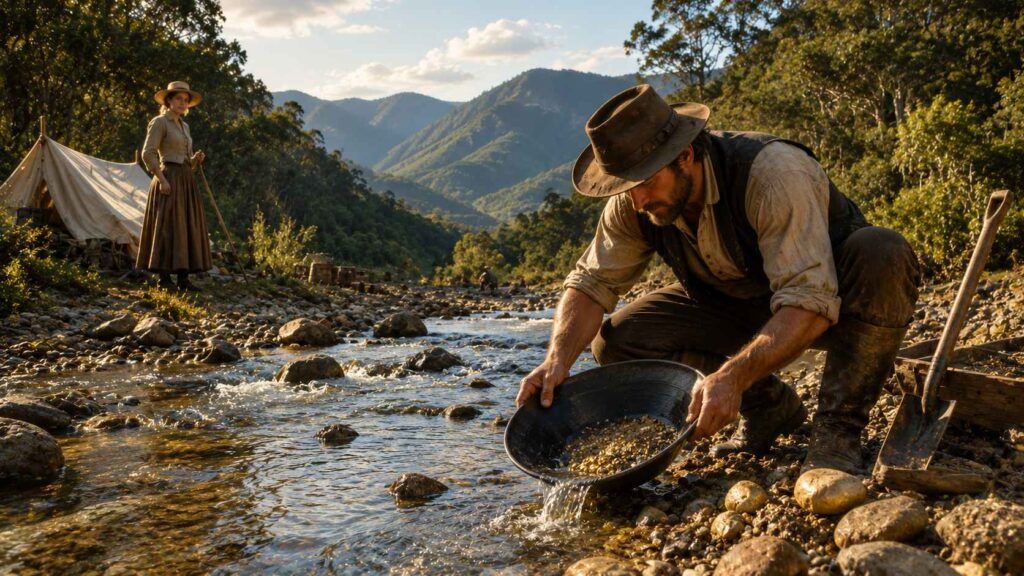
The first gold reported in Golden Bay was in 1856. When people think of New Zealand’s great gold rushes, places like Otago and the West Coast often come to mind first. But the story of New Zealand’s gold mining actually began much earlier, in the quiet valleys of Golden Bay.
In 1856, small traces of gold were discovered in the Aorere Valley, marking the beginning of what would soon become one of the most important chapters in the region’s history.
At first, the discovery attracted little attention. No one could have imagined that these tiny flakes of gold would eventually spark New Zealand’s first major South Island gold rush.
A Quiet Descovery In The Aorere Valley
By the mid-1850s, European settlers had been living in Golden Bay for over a decade. Farmers, timber workers, fishermen, and labourers were slowly building communities throughout the region.
While working along the rivers of the Aorere Valley, several settlers and prospectors began noticing tiny pieces of gold mixed among the river gravels.
The finds were modest.
Rather than large nuggets, the gold appeared as fine flakes and small particles carried downstream over thousands of years.
Although exciting, the discovery wasn’t enough to convince people that Golden Bay held a significant goldfield.
Why Was Gold Found In The Aorere?
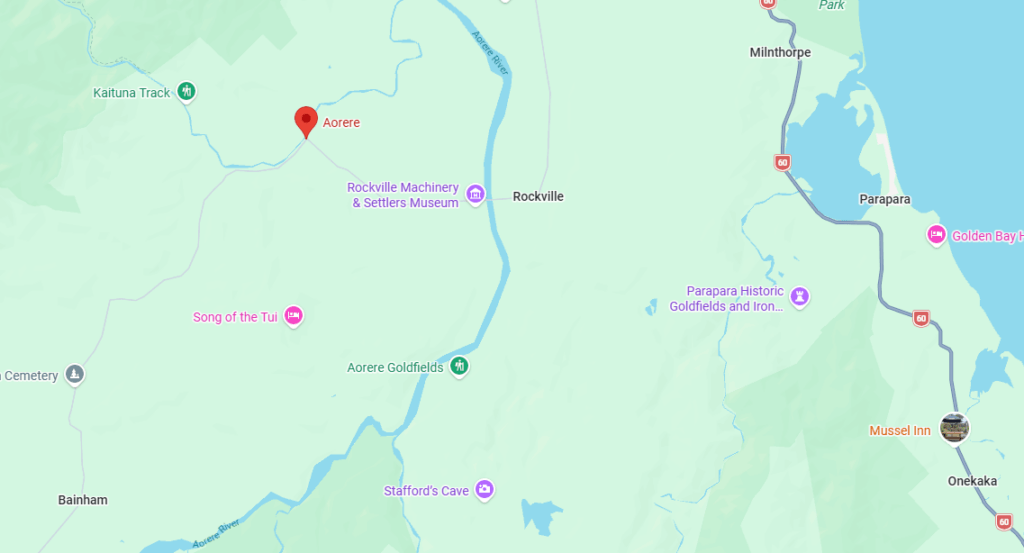
The Aorere River begins high in the rugged mountains surrounding Golden Bay.
Over millions of years, natural erosion wore away quartz-bearing rock deep within the mountain ranges. As the rock broke down, tiny particles of gold were released and carried into the rivers.
Because gold is extremely heavy, it settled into cracks, crevices, and gravel bars along the riverbeds.
These natural deposits are known as alluvial gold, and they would later become the focus of thousands of hopeful miners.
Even today, recreational prospectors continue to find small amounts of alluvial gold in parts of the Aorere catchment.
News Travels Slowly
Unlike today, there were no newspapers reporting discoveries within hours, no social media, and no instant communication.
News travelled by:
- Horseback
- Coastal sailing vessels
- Personal letters
- Word of mouth
A rumour about gold could take weeks or even months to spread beyond Golden Bay.
Because the initial discoveries were relatively small, many people dismissed the reports as little more than local curiosity.
Early Prospectors Began Exploring
Although there was no rush in 1856, the discovery encouraged a handful of adventurous prospectors to investigate the surrounding valleys.
Attention quickly turned towards areas such as:
- The Aorere River
- Slate River
- Boulder River
- Washbourne Creek
Many of these waterways would later become famous for producing rich alluvial gold deposits.
The early prospectors worked with simple equipment such as:
- Gold pans
- Shovels
- Picks
- Cradles (rockers)
Mining was slow, physically demanding work, and success was far from guaranteed.
A Discovery That Almost Went Unnoticed
Looking back today, it’s remarkable how quietly Golden Bay’s gold story began.
There were:
- No crowds of miners.
- No booming settlements.
- No overnight fortunes.
Just a few small discoveries hidden among the gravels of a remote valley.
But those first flakes proved something incredibly important:
Gold was here.
That single fact would soon change everything.
The Spark Before The Rush
As prospectors continued searching the rivers during the following months, more encouraging discoveries were made.
Confidence slowly grew.
Word spread beyond Golden Bay.
More experienced miners arrived to test the rivers for themselves.
Then, in 1857, several much richer discoveries were made in the Aorere Valley and its tributaries.
Those discoveries transformed a quiet farming district into one of New Zealand’s busiest frontier communities almost overnight.
The Beginning Of Golden Bay's Gold Legacy
Although the discovery of 1856 wasn’t spectacular by itself, it deserves an important place in New Zealand’s history.
It marked the first confirmed signs that Golden Bay contained commercially significant alluvial gold.
Without these early discoveries, there may never have been the famous Aorere Gold Rush that followed.
Every gold rush has a beginning.
For Golden Bay, it all started with a few tiny flakes glinting in the waters of the Aorere River.
Looking Ahead
By 1857, prospectors were uncovering much richer deposits throughout the Aorere Valley.
News spread quickly across New Zealand and beyond, attracting hundreds, and eventually thousands, of hopeful miners eager to strike it rich.
In the next chapter, we’ll explore the Aorere Gold Rush of 1857, the event that firmly established Golden Bay as the birthplace of New Zealand’s first major South Island gold rush.