
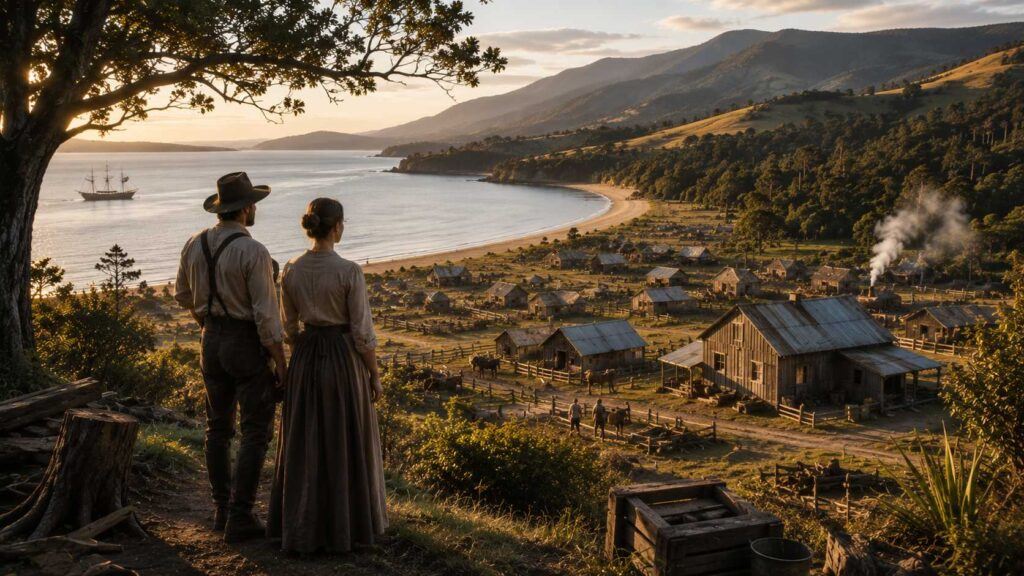
Long before Golden Bay became known for its gold rush, the region was attracting attention for another reason…its incredible natural resources.
Fertile land, dense native forests, abundant seafood, and sheltered harbours made Mohua, now known as Golden Bay, an appealing destination for some of New Zealand’s earliest European settlers.
Although gold had not yet been discovered, the arrival of European settlers in the 1840s laid the foundations for the communities, roads, and industries that would eventually support one of New Zealand’s earliest gold rushes.
By 1842 The First European Settlers Arrive
By 1842, small groups of European settlers had begun establishing themselves around what is now Tākaka and the western side of the bay.
Life was far from easy.
There were:
- No established roads.
- Very few buildings.
- Thick native bush covering much of the landscape.
- Rivers that frequently flooded after heavy rain.
Most settlers built simple timber homes using materials sourced directly from the surrounding forests.
Every day required hard physical work simply to survive.
Building a Living From The Land
Without gold to chase, settlers relied almost entirely on the land itself.
Early industries included:
- Farming
- Small farms were established on fertile flats where crops and livestock could be raised.
- Timber
- Golden Bay’s towering native forests supplied valuable timber for homes, fencing, boats, and future development.
- Fishing
- The sheltered waters of the bay provided an abundant supply of fish and shellfish, helping sustain growing communities.
- Coal and Limestone
- Even before gold was discovered, settlers recognised the area’s rich mineral resources.
Small-scale extraction of coal and limestone began, industries that would continue to play an important role in Golden Bay’s economy for many decades.
- Even before gold was discovered, settlers recognised the area’s rich mineral resources.
Relationships With Maori
European settlers entered a region that had been home to Māori communities for centuries.
The iwi of Mohua possessed extensive knowledge of:
- Rivers and waterways
- Seasonal food gathering
- Forest resources
- Mountain passes
- Weather patterns
Although relations varied over time, many settlers benefited from local knowledge that helped them adapt to an unfamiliar landscape.
The region’s history is one of two cultures gradually shaping the future of Golden Bay together, though not without challenges that were experienced throughout New Zealand during this period.
The Challenge Of Isolation
One of the greatest obstacles facing early settlers was isolation.
Travel between Nelson and Golden Bay was slow and difficult.
Without modern roads, people travelled by:
- Coastal sailing vessels
Horseback - Walking rough bush tracks
- Crossing rivers without bridges
Simple tasks such as receiving supplies or sending mail could take weeks.
Despite these hardships, communities slowly grew as more families chose to settle in the region.
A Community Begins To Form
As more settlers arrived, small settlements started taking shape.
Basic infrastructure gradually appeared:
- Schools
- Churches
- General stores
- Wharves
- Farms
- Timber mills
These early communities created the framework that would later support much larger populations during the gold rush years.
Without these first settlers, the rapid growth of the late 1850s would have been almost impossible.
Preparing The Way For Gold
Although nobody realised it at the time, the rivers winding through Golden Bay held something far more valuable than fertile soil.
As settlers cleared land, built tracks, and explored the valleys, they became increasingly familiar with rivers such as the Aorere, Slate, and Boulder.
Within just fifteen years, these waterways would become the centre of one of New Zealand’s earliest gold rushes.
The communities established during the 1840s would suddenly find themselves transformed as thousands of hopeful miners poured into the district in search of fortune.
The Legacy Of The First European Settlers
Today, it’s easy to think of Golden Bay’s history beginning with gold, but the reality is very different.
The region’s first European settlers arrived seeking a quieter life built around farming, timber, fishing, and natural resources.
Their determination helped establish the towns, infrastructure, and industries that allowed Golden Bay to grow into one of New Zealand’s most fascinating regions.
When gold was finally discovered in the 1850s, it wasn’t an untouched wilderness waiting to be explored, it was already becoming a thriving community with deep Māori roots and an emerging European presence.