
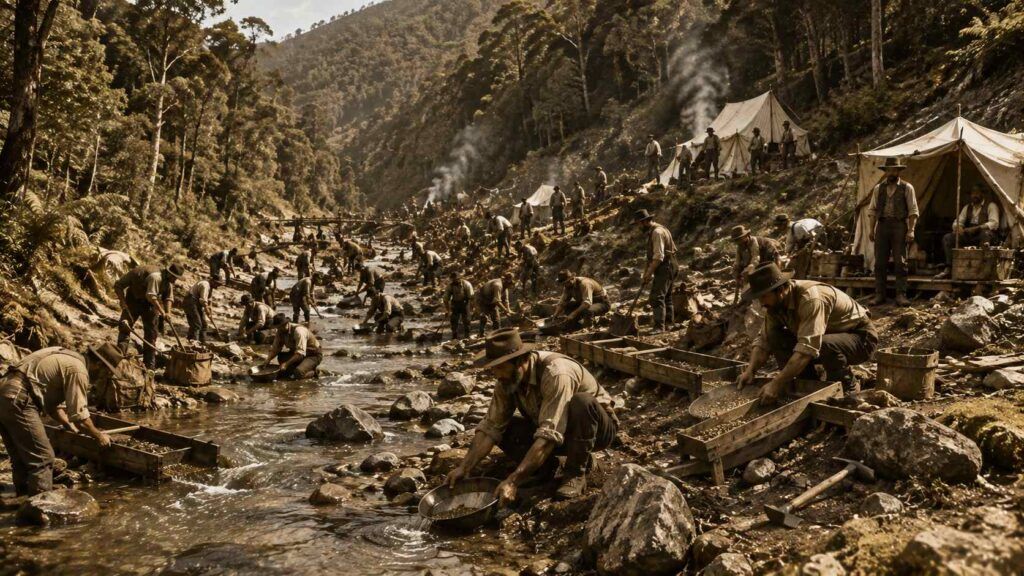
The Aorere Gold Rush of 1857–1858 transformed a quiet corner of Golden Bay into one of New Zealand’s earliest gold-mining settlements. What had begun with small discoveries and a handful of determined prospectors quickly grew into something much bigger as news of payable gold spread beyond the region.
Miners arrived looking for opportunity. Merchants followed looking for customers. Camps appeared beside previously quiet rivers and creeks, while Collingwood became the gateway to an increasingly busy goldfield.
For a brief but remarkable period, gold fever had arrived in Golden Bay.
How The Aorere Gold Rush Began
Gold had been reported in the Aorere district before 1857, but the early discoveries weren’t enough to create a full-scale rush.
That changed when prospectors began finding payable quantities of alluvial gold.
William Lightband was one of the important figures during this early period. Having gained experience on the Australian goldfields, Lightband recognised the potential of the Aorere district and continued prospecting when others remained uncertain.
Then came increasingly encouraging discoveries.
One of the most important occurred around the Slate River, where historical accounts record three miners recovering approximately 100 ounces of gold over seven weeks.
That was the kind of story that travelled quickly.
Gold began appearing in Nelson, reports of successful claims circulated, and suddenly the remote valleys across Tasman Bay didn’t seem quite so remote.
People wanted in.
By May 1857, contemporary estimates suggested around 1,000 men were already working the Aorere diggings. Over the wider life of the field, historical estimates commonly suggest that roughly 2,000–2,500 people were drawn into the district, although exact numbers are difficult to establish.
The quiet valley was becoming a goldfield.
What Attracted Miners To The Aorere?
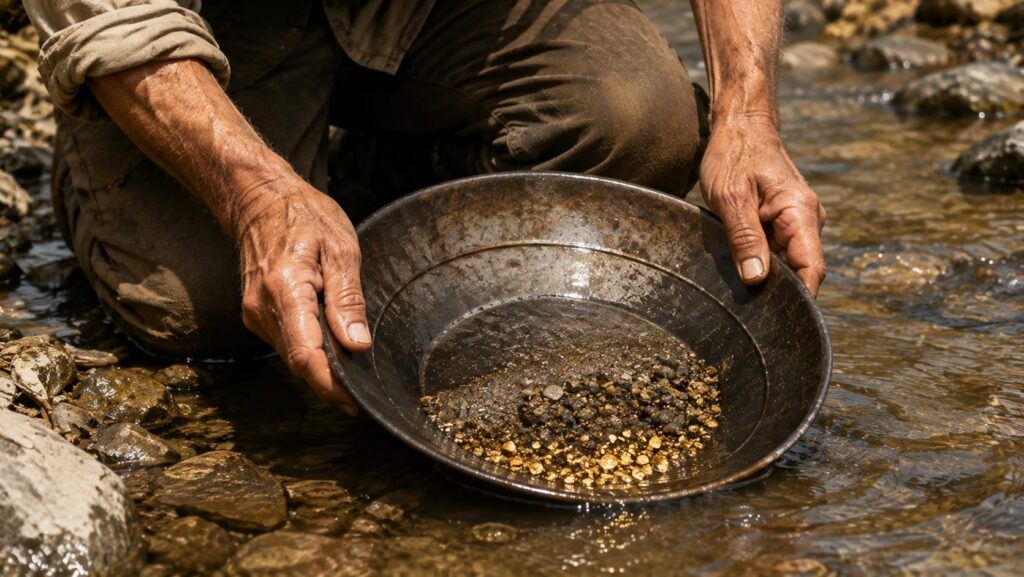
For someone living in the 1850s, the possibility of finding gold represented something extraordinary.
A successful claim could potentially earn far more than months of ordinary labor.
The attraction was simple:
- Gold could be recovered using relatively basic equipment.
- Early reports suggested some miners were earning good returns.
- New ground was constantly being explored.
- The gold was largely alluvial and could sometimes be recovered directly from river gravels.
- Experienced miners arriving from Australia brought new knowledge and techniques.
- There was always the possibility that the next creek or gravel bar could contain a rich deposit.
But there was one enormous catch… Nobody knew exactly where the richest gold was hiding.
For every miner who found a productive claim, others spent days or weeks shifting gravel for very little reward.
That uncertainty was part of gold-rush life.
Life During The Aorere Gold Rush
The romantic image of a prospector quietly swirling a gold pan beside a beautiful river tells only a small part of the story.
Gold mining was hard physical work.
Miners stood in cold water, moved rocks, dug through gravel, and carried heavy equipment through difficult country. Much of the goldfield lay inland, away from the developing settlement at Collingwood, so supplies had to be transported into increasingly remote areas.
The Aorere Valley landscape itself presented constant challenges.
Heavy rain could raise river levels quickly. Tracks became muddy. Dense native bush made travel difficult, and miners working deeper in the valley lived in basic camps far removed from the comforts of town.
A typical miner might own little more than:
- A shovel and pick
- A gold pan
- A cradle or rocker
- Basic cooking equipment
- Blankets and spare clothing
- A canvas tent
- Food and provisions
- Eventually, sluicing equipment for processing larger quantities of gravel
As the workings became more established, mining techniques also became increasingly sophisticated.
Rather than processing a single pan of gravel at a time, miners constructed sluice boxes and water races that allowed much greater quantities of material to be washed.
Water became almost as important as gold itself.
If miners could control the water, they could process more gravel.
And the more gravel they processed, the greater their chances of finding gold.
A Goldfield Begins To Take Shape
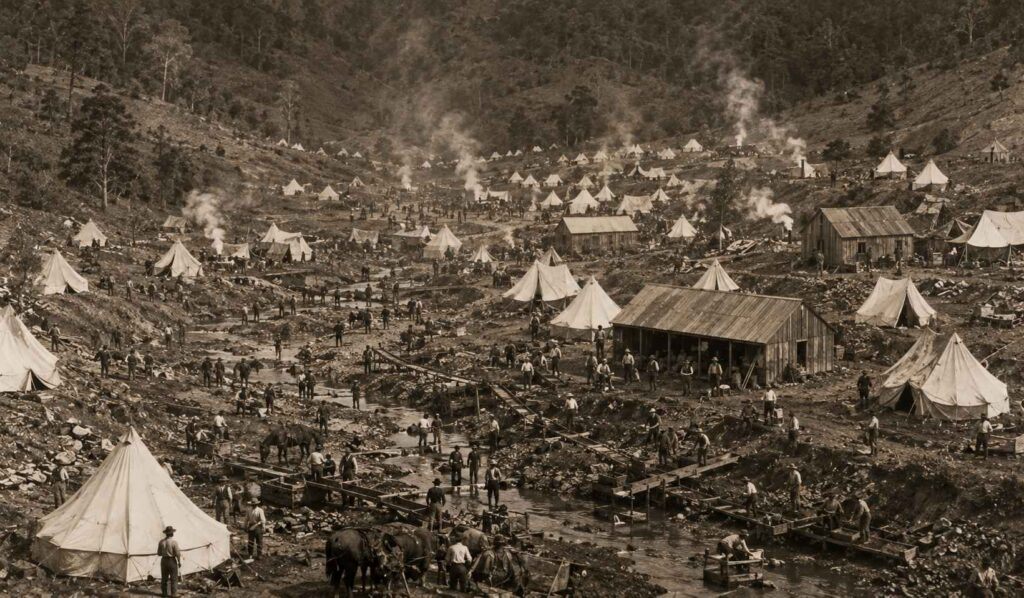
What had initially been scattered groups of prospectors gradually developed into something resembling a temporary community.
Imagine walking into the Aorere Valley during the height of the rush.
Instead of the quiet river and bush that had existed only a short time earlier, you might have encountered:
- Canvas tents scattered along the valley
- Smoke rising from campfires
- Men carrying picks and shovels
- Sluice boxes running beside streams
- Horses transporting supplies
- Merchants selling equipment and food
- Fresh claims being marked out
- Groups discussing the latest discoveries
- Prospectors disappearing further upriver looking for untouched ground
There would have been excitement, frustration, exhaustion and probably plenty of exaggeration.
One miner finding a rich pocket could send dozens of others scrambling towards the same creek.
Such was gold fever.
Collingwood and the Aorere Gold Rush Boom
The miners may have been working inland, but Collingwood became the doorway to the goldfields.
Its position near the mouth of the Aorere River made the settlement an important arrival and supply point.
Boats brought miners and goods across from Nelson, while businesses emerged to serve the rapidly growing population.
Suddenly there was demand for almost everything.
Food, boots, blankets, mining equipment, alcohol, accommodation, transport and building materials could all be sold to miners.
And that meant you didn’t necessarily need to find gold to make money from the gold rush.
Merchants, storekeepers, publicans, transport operators and tradespeople could potentially benefit from the population flooding into the district.
This pattern would later be repeated across countless goldfields around the world.
Sometimes the people selling shovels did better than the people using them.
What Happened To The Aorere Gold Rush?
Like most gold rushes, the excitement couldn’t continue forever.
The easiest alluvial deposits were naturally the first to be discovered and worked.
As more miners arrived, competition increased.
Productive ground became harder to find.
Some prospectors pushed deeper into tributaries such as the Slate and Boulder Rivers, while others began looking for entirely new areas.
The pattern was becoming familiar:
- Gold was discovered.
- News of successful claims spread.
- Large numbers of miners arrived.
- The easiest deposits were rapidly worked.
- Returns became less predictable.
- Miners began searching elsewhere.
By the end of the 1850s, the initial excitement surrounding the Aorere field was beginning to fade.
Then, in 1861, Gabriel Read’s discovery in Otago triggered a vastly larger gold rush.
For adventurous miners constantly searching for the next opportunity, Otago was difficult to ignore.
Many simply packed their belongings and moved on.
But mining in Golden Bay didn’t disappear.
Prospectors continued working the region, and later generations would return with better equipment and new methods capable of processing ground that earlier miners couldn’t work economically.
The first great rush, however, was coming to an end.
The Legacy Of The Aorere Gold Rush
The amount of gold recovered is only one way of measuring the importance of a gold rush.
The Aorere Gold Rush helped reshape Golden Bay.
It brought new people into the region, encouraged exploration of its rivers and valleys, expanded Collingwood and created opportunities for businesses that had little to do directly with mining.
It also left something less tangible behind.
Stories.
Stories of miners walking into the bush carrying little more than a shovel and gold pan.
Stories of fortunes found and fortunes missed.
Stories of rivers suddenly crowded with people convinced that somewhere beneath their feet was the discovery that could change their lives.
And perhaps most importantly, the rush helped give the region an identity that survives today.
The name Golden Bay itself became associated with the discoveries being made around the Aorere.
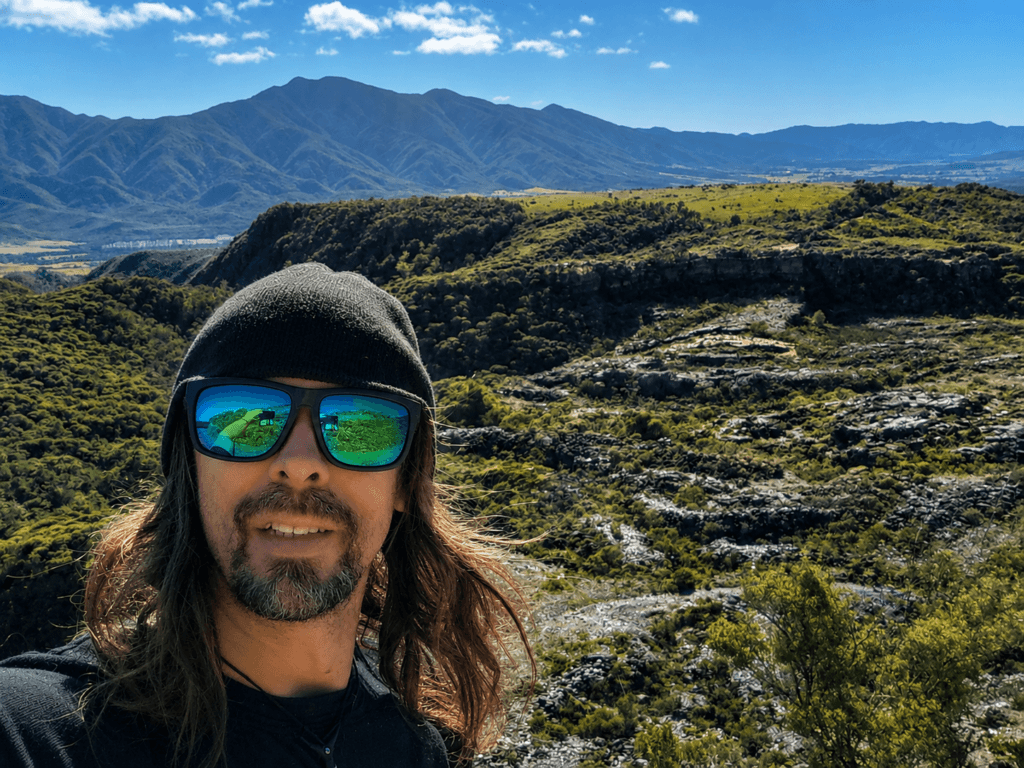
More than 160 years later, gold can still be found in parts of the district, and traces of the old workings remain hidden throughout the landscape.
But Golden Bay’s real treasure has become much bigger than the metal beneath its rivers.
It’s the history, the landscapes, the people, the products and the stories that grew from this remarkable little corner of New Zealand.
The miners may have moved on.
The Aorere Gold Rush became history.
But the story of Golden Bay was only just getting started.